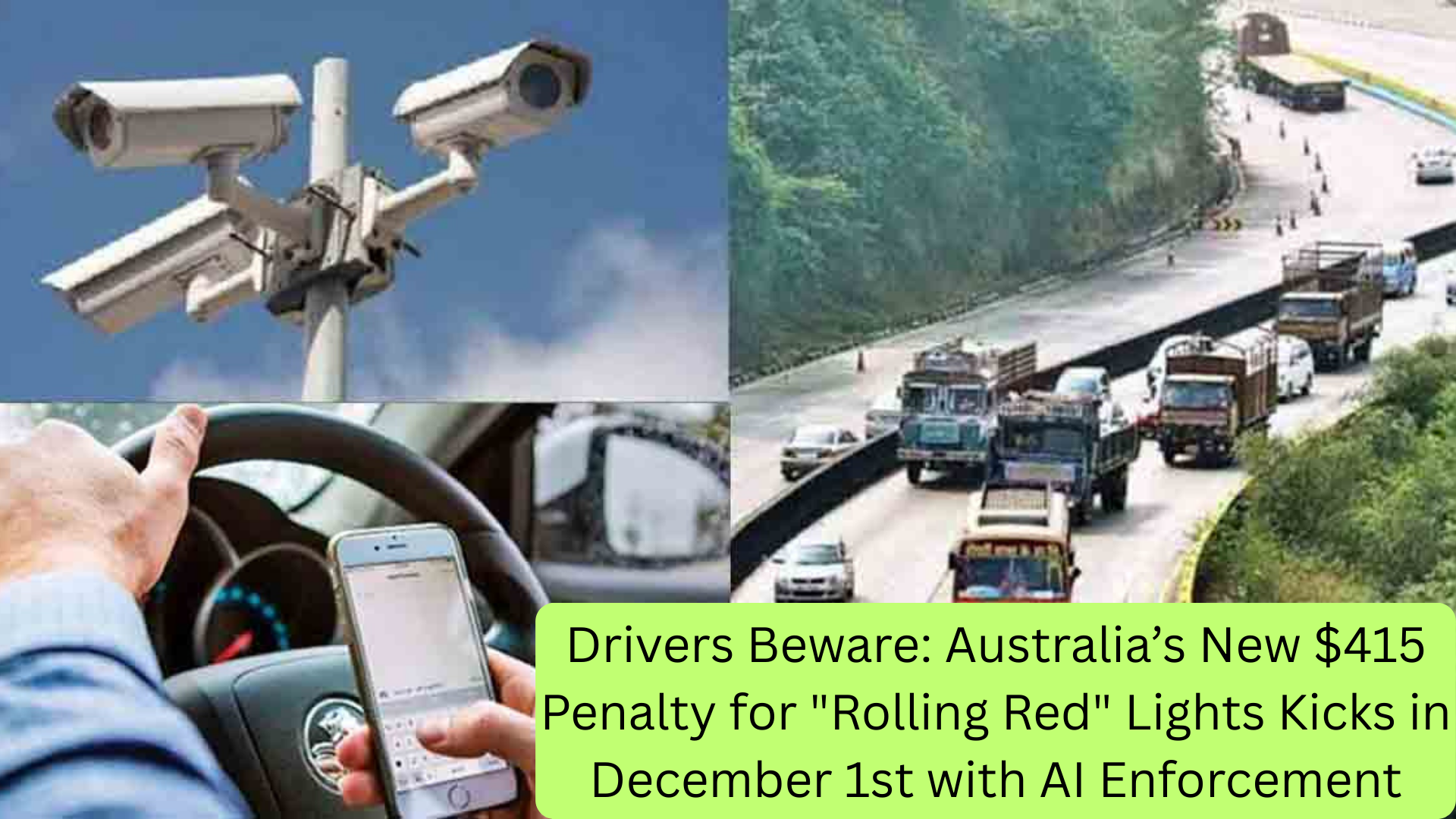
Imagine the instant dread as a fine notification arrives on your phone, not days later, but minutes after a momentary lapse: a slight “rolling red” violation at a complex intersection, a micro-second decision caught by a tireless, impartial machine. This is the new enforcement reality for Australian drivers, as a sophisticated network of AI Red-Light Cameras begins full operation from 1st December 2025, carrying an immediate, standardized $415 Rolling-Red Fine designed for maximum impact and compliance.
This sweeping technological overhaul represents a significant shift in road safety strategy in Australia. The deployment is driven by a zero-tolerance policy targeting minor, yet statistically dangerous, red-light infractions that often slip past older camera systems or human observation. The new AI Red-Light Cameras are not just replacements; they are a quantum leap in detection, designed to enforce traffic laws with relentless precision, ensuring that safety compliance is mandatory across the board.
Background: Why the AI Revolution is Needed
The impetus behind the AI Red-Light Cameras is the sobering reality of intersection safety in Australia. While major crashes involving flagrant red-light running have decreased due to existing cameras, a persistent and dangerous trend remains: the “rolling red” or “red-light creep”—where drivers enter the intersection marginally after the light turns red, or fail to come to a complete stop before turning.
Government data from 2025 indicates that intersection-related collisions account for over 40% of all serious injury crashes annually across major metropolitan areas. This figure has remained stubbornly high, despite awareness campaigns. The previous generation of red-light cameras often had detection gaps, focused primarily on vehicles fully entering the intersection seconds after the light change, missing the quick, low-speed, yet high-risk rolling infringements.
The new AI Red-Light Cameras are equipped with advanced computer vision and machine learning algorithms, allowing them to detect a vehicle’s speed and position relative to the stop line in milliseconds. This precision allows for the reliable, automated issuing of the $415 Rolling-Red Fine, closing the enforcement loophole that previously allowed marginal, dangerous violations to occur frequently. The 1st December 2025 activation date marks the transition from a human-monitored system to a machine-enforced standard of absolute compliance.
The implementation is viewed as a necessary, if controversial, step towards achieving the government’s ambitious goal of a 20% reduction in intersection-related fatalities over the next five years. The widespread deployment across high-risk corridors in Australia is intended to instantly change driver behavior through the certainty of the $415 Rolling-Red Fine.
What’s New: Key Changes and Instant Penalties
The launch of the AI Red-Light Cameras introduces fundamental changes to how red-light violations are detected, processed, and penalized. Drivers must recognize that the standards of compliance have moved from ‘near enough is good enough’ to ‘absolute stop at the line.’
Key changes under the AI Red-Light Cameras rollout, effective 1st December 2025, include:
- Precision Detection of “Rolling Red”: The AI systems utilize multiple high-resolution lenses and predictive software to detect cars that fail to come to a complete standstill before the red light period begins, or before proceeding through a red light to turn. The threshold for the $415 Rolling-Red Fine is now measured in centimeters and milliseconds, leaving no margin for error.
- Instant Fine Processing: The AI system can automatically verify the license plate and vehicle registration details, cross-reference the violation against the traffic signal data, and initiate the fine issuance process, significantly cutting down the processing time that previously took days or weeks.
- The $415 Rolling-Red Fine: This standardized penalty for all red-light running offences detected by the new AI system is non-negotiable and applies across all states participating in the coordinated rollout. The high amount reflects the severity of the safety risk posed by these violations.
- Demerit Point Impact: All violations detected by the AI Red-Light Cameras will incur 3 demerit points across Australia, a penalty that can be doubled during peak holiday seasons or long weekends, significantly increasing the risk of license suspension.
- Data Reliability: The cameras capture and log exponentially more data points than previous models, making the evidence highly robust for any appeal process. This high data integrity is central to the system’s credibility.
- Widespread Network Activation: While the initial phase covers 150 high-priority intersections, the network will be expanded rapidly throughout 2026 to cover all major city centers and high-speed arterial roads in Australia.
The Human Angle and Real Stories
The move to immediate, automated enforcement has caused significant anxiety among professional drivers and commuters alike. For individuals who rely on driving for their livelihood, the certainty of the $415 Rolling-Red Fine poses a constant threat.
David Chen, a 54-year-old delivery driver in Melbourne, is deeply concerned about the activation of the AI Red-Light Cameras. “My job requires me to be in complex intersections all day, every day. I know the rules, but with heavy traffic and long shifts, stopping precisely on the line 100 times a day is asking a lot,” Mr. Chen shared. “A $415 fine and three demerit points is a week’s profit for me. I’m now driving with genuine fear, constantly looking down at the white line instead of watching the traffic around me. It feels like the system is set up to punish the smallest mistake.”
However, for families impacted by intersection accidents, the new measure represents a long-overdue commitment to safety. Ms. Priya Sharma, whose daughter was injured in a minor intersection collision two years ago, welcomes the change. “The driver who hit my daughter ran a fraction of a second late, and the old camera missed it. This new $415 Rolling-Red Fine is exactly what’s needed to make people treat the red light as a hard stop. It’s not about revenue; it’s about preventing avoidable injuries in Australia.”
Official Statements and Commitment to Safety
Government officials have been firm in defending the rollout of the AI Red-Light Cameras, stating that the technology is a necessary tool to save lives and is not primarily a revenue-generating scheme. They emphasize that the technology detects only genuine breaches of the law.
Minister for Road Safety, Minister Sarah Peterson, confirmed the activation date and the penalty. “From 1st December 2025, the AI Red-Light Cameras will provide unyielding enforcement of the traffic code. If you adhere to the law and stop at the line when the light is red, you will not receive a fine,” Minister Peterson stated unequivocally. “The introduction of the $415 Rolling-Red Fine is a safety measure with zero tolerance for dangerous encroachment. The technology is impartial, accurate, and its sole mandate is to reduce the devastating toll of intersection crashes in Australia.”
Minister Peterson further advised that extensive public awareness campaigns are being rolled out prior to the 1st December 2025 launch, ensuring that every driver is aware of the change in enforcement standards.
Expert Analysis and Data Insight
The deployment of AI Red-Light Cameras is being closely monitored by traffic engineers and legal experts worldwide. Dr. James O’Connor, a leading specialist in intelligent transport systems at the Australian Institute of Road Technology, provided crucial context on the technology’s expected impact.
“The key differentiator in this generation of cameras is the use of deep learning models that can identify the exact boundary of the intersection and track minor movements with millimeter accuracy. This eliminates the grey area that drivers previously exploited,” Dr. O’Connor explained. “While the $415 Rolling-Red Fine sounds harsh, the certainty of enforcement is what changes behavior. Preliminary trials in a closed testing environment in 2025 showed a 22% reduction in all red-light violations within three months of the AI system’s activation.”
Dr. O’Connor noted that the high statistical accuracy of the system (pegged at 99.8% by manufacturers) significantly reduces the opportunity for successful appeals based on technical error. The focus now shifts from proving if a violation occurred to mitigating the reasons why it occurred. This level of enforcement detail is unprecedented in Australia and sets a global benchmark for future traffic enforcement initiatives.
Comparison of Major Australian Driving Fines
To illustrate the seriousness with which the government views the red-light violation, the new $415 Rolling-Red Fine can be compared with other common road offenses in Australia. This comparison underscores the substantial financial impact of being caught by the new AI Red-Light Cameras.
| Offence Category | Detection Method | Penalty (Approx.) | Demerit Points | Effective Date (AI Fine) |
|---|---|---|---|---|
| Red Light / Rolling Red | New AI Camera | $415 | 3 | Dec 2025 |
| Handheld Mobile Phone Use | AI/Fixed Camera | $577 | 4 | N/A (Existing) |
| Low Range Speeding (10-20km/h over) | Fixed/Mobile Radar | $287 | 3 | N/A (Existing) |
| No Seatbelt (Driver) | Human/Mobile Camera | $349 | 3 | N/A (Existing) |
The table confirms that the $415 Rolling-Red Fine places this specific infraction on par with highly illegal and dangerous driving behaviors, signaling the high-priority safety status of intersection compliance in Australia.
Impact and What Readers Should Do
The primary impact of the AI Red-Light Cameras rollout from 1st December 2025 is the immediate need for drivers to adjust their habits to reflect absolute zero tolerance for red lights. The certainty of the $415 Rolling-Red Fine means that complacency is no longer an option.
First, Adjust Your Stopping Distance: When approaching amber lights, focus on stopping completely before the white line, even if it feels possible to clear the intersection. The AI will not allow ‘rolling stops’ or marginal entries. Second, Verify Notification Details: Ensure your license and vehicle registration details are current with the relevant state authority. The instant fine system relies on accurate records to send the notice directly to the registered address or digital portal, often within minutes of the infraction.
Finally, Understand the Appeals Process: While the technology is highly accurate, genuine errors can occur. If you intend to appeal the $415 Rolling-Red Fine, gather evidence promptly, such as dashcam footage or third-party witnesses. Appeals must be based on genuine necessity or error, not simply a challenge to the detection technology. The responsible action is heightened awareness and scrupulous compliance.
The activation of the AI Red-Light Cameras on 1st December 2025 and the introduction of the $415 Rolling-Red Fine mark a permanent, significant change in traffic enforcement in Australia. This is a clear governmental mandate to eliminate dangerous intersection violations through technology.
For Australian drivers, the message is one of necessary vigilance: the system is impartial, the penalty is severe, and the enforcement is instant. By adopting a zero-tolerance approach to red lights, drivers can contribute to safer roads, protect their licenses, and avoid the substantial $415 Rolling-Red Fine throughout 2025 and beyond.









Leave a Comment