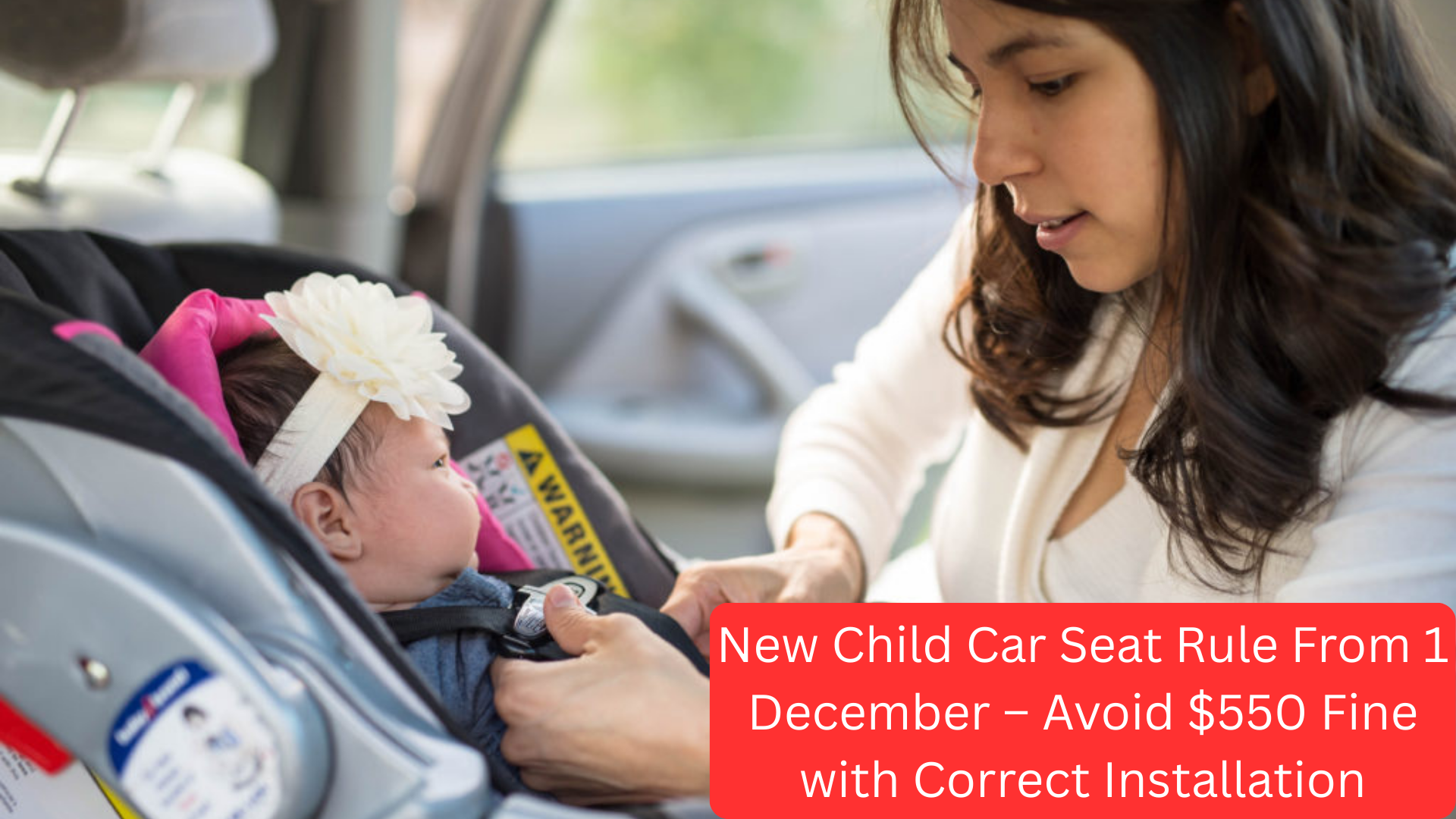
Imagine the unthinkable: being stopped by police, not for speeding, but because your child’s car seat—the very device meant to protect them—is deemed incorrectly installed under a New Child Car Seat Rule From 1 December. For parents across Australia, the stakes are now higher, as authorities are implementing stricter compliance and enforcement measures for child restraints. This change means Parents Warned of $550 Fine for Wrong Installation if their seats do not meet the updated standards and fitting requirements, effective 1 December 2025.
This regulatory update is not about changing which children must be restrained, but how those restraints must be used, focusing sharply on correct fitting to maximize safety. The heightened enforcement, coupled with the potential for a $550 Fine, underscores the seriousness of the new law, putting child safety firmly back in the spotlight for every motorist carrying children in Australia.
Background: The Need for the New Rule
While Australia has long had stringent laws regarding child restraints, a significant body of research indicates that a majority of parents incorrectly install or misuse their seats. Studies often show that up to 80% of car seats have at least one critical error, such as a twisted harness, a loose restraint, or an incorrect anchor point connection.
The New Child Car Seat Rule From 1 December addresses this crucial failure point by standardizing and simplifying the fitting process across state and territory lines, aligning enforcement with best-practice safety recommendations. The goal is simple: reduce preventable injuries and fatalities by ensuring child restraints perform optimally in the event of a crash.
What’s New: Key Changes and Penalties
The changes rolling out from 1 December 2025 focus primarily on two areas: ensuring seats meet the latest AS/NZS standards, and enforcing the technical requirements of installation, particularly regarding tether straps and harness tension.
Key aspects of the New Child Car Seat Rule From 1 December:
- Focus on Installation: The regulation tightens the definition of “correctly installed.” This includes ensuring the seat belt is fully engaged, the seat moves less than 2.5cm at the belt path, and the top tether strap is tight and attached to the correct anchor point.
- Enforcement and Penalty: Parents Warned of $550 Fine for Wrong Installation. The penalty applies to incorrect usage or installation that compromises the child’s safety, treating poor fitting as seriously as failing to use a seat at all.
- Updated Standards: While existing seats meeting the previous standard (AS/NZS 1754:2013) remain legal, new seats manufactured after this date must comply with the newest iteration of the standard, featuring improved side-impact protection.
- Child Restraint Use: The core age-based requirements (rear-facing for under 6 months, forward-facing up to 4 years, booster until 7 years) remain the same, but the emphasis is now on the quality of the fit.
The Human Angle: A Parent’s Stress and Relief
The news of the substantial $550 Fine has prompted many parents to immediately check their vehicles. For young families, the potential for a fine adds significant pressure, but the safety motivation is paramount.
Sarah Chen, a mother of a two-year-old and a baby due next year, admitted to feeling anxious about the change. “I thought I knew how to do it—you click it in and go. But hearing about the $550 Fine made me realize I need to be 100% certain,” Ms. Chen said. “I booked a free check with a certified fitter, and they found my harness was too loose. That new rule forced me to prioritize safety over assumption.”
Mr. Robert Jones, a grandfather who regularly drives his grandchildren, welcomed the strictness. “Children’s safety is non-negotiable. If a $550 Fine is what it takes to get people to install these things properly, then it’s worth it,” Mr. Jones commented. “The rules give me clarity on exactly what ‘safe’ means, especially with the different types of seats available now.”
Official Statements and Expert Analysis
A spokesperson for the national transport authority confirmed the increase in enforcement activity starting 1 December 2025. “We are not trying to fine families; we are trying to save lives. The New Child Car Seat Rule From 1 December is a public health measure,” the official stated. “The penalty reflects the severe risk posed by a poorly installed restraint. Incorrect installation reduces the seat’s protection performance by an average of 50% in an impact.”
Professor Clara Davies, a specialist in paediatric injury prevention at an Australian university, strongly endorsed the heightened focus. “The data consistently shows that the human element—the installation—is the weakest link. By making the penalty for Wrong Installation significant, the government is incentivizing parents to seek professional checks or thoroughly learn how to use their product manuals,” Dr. Davies explained. “This change will undoubtedly lead to a tangible reduction in non-fatal injuries caused by improper restraint use.”
Comparison of Penalties and Offenses
The severity of the penalty for Wrong Installation reflects how seriously the law now views misuse, aligning it with other dangerous driving offenses in Australia.
| Offense Description | Penalty in Australia (Approx.) | Type of Risk |
|---|---|---|
| Incorrect Car Seat Installation | Up to $550 Fine & Demerit Points | Direct life-threatening risk to a child occupant |
| Speeding (Low Range) | Approx. $300 Fine & Demerit Points | General risk to road users |
| Using Mobile Phone while Driving | Approx. $1,000 Fine & Demerit Points | Distraction risk |
| Failing to Wear Seatbelt (Adult) | Approx. $350 Fine & Demerit Points | Direct risk to adult occupant |
Impact and What Readers Should Do
The New Child Car Seat Rule From 1 December is an urgent call for all parents and caregivers in Australia to take immediate action. Ignoring the update could not only lead to a $550 Fine but, more importantly, compromise a child’s safety.
Action Step 1: Read the Manual: Pull out the car seat manual and re-read the installation steps, paying close attention to belt routing, harness height, and the use of the top tether strap.
Action Step 2: Get a Check-Up: Many state road safety organizations and child safety groups offer free or low-cost car seat checking clinics. Book an appointment immediately to have your seat certified by an Authorized Restraint Fitter before the 1 December 2025 deadline.
Action Step 3: Check Harness Tension: Ensure the harness straps are always tight enough. The general rule is the ‘Pinch Test’—you should not be able to pinch any slack material on the vertical harness strap at the child’s shoulder.
The implementation of the New Child Car Seat Rule From 1 December in Australia is a major regulatory step that reinforces child road safety. While the prospect of a $550 Fine for Wrong Installation is a stern warning, the true motivation is the protection of children. By understanding the new emphasis on correct installation and seeking verification, parents can ensure their seats are legally compliant and, most crucially, provide the maximum protection for their young passengers.












Leave a Comment