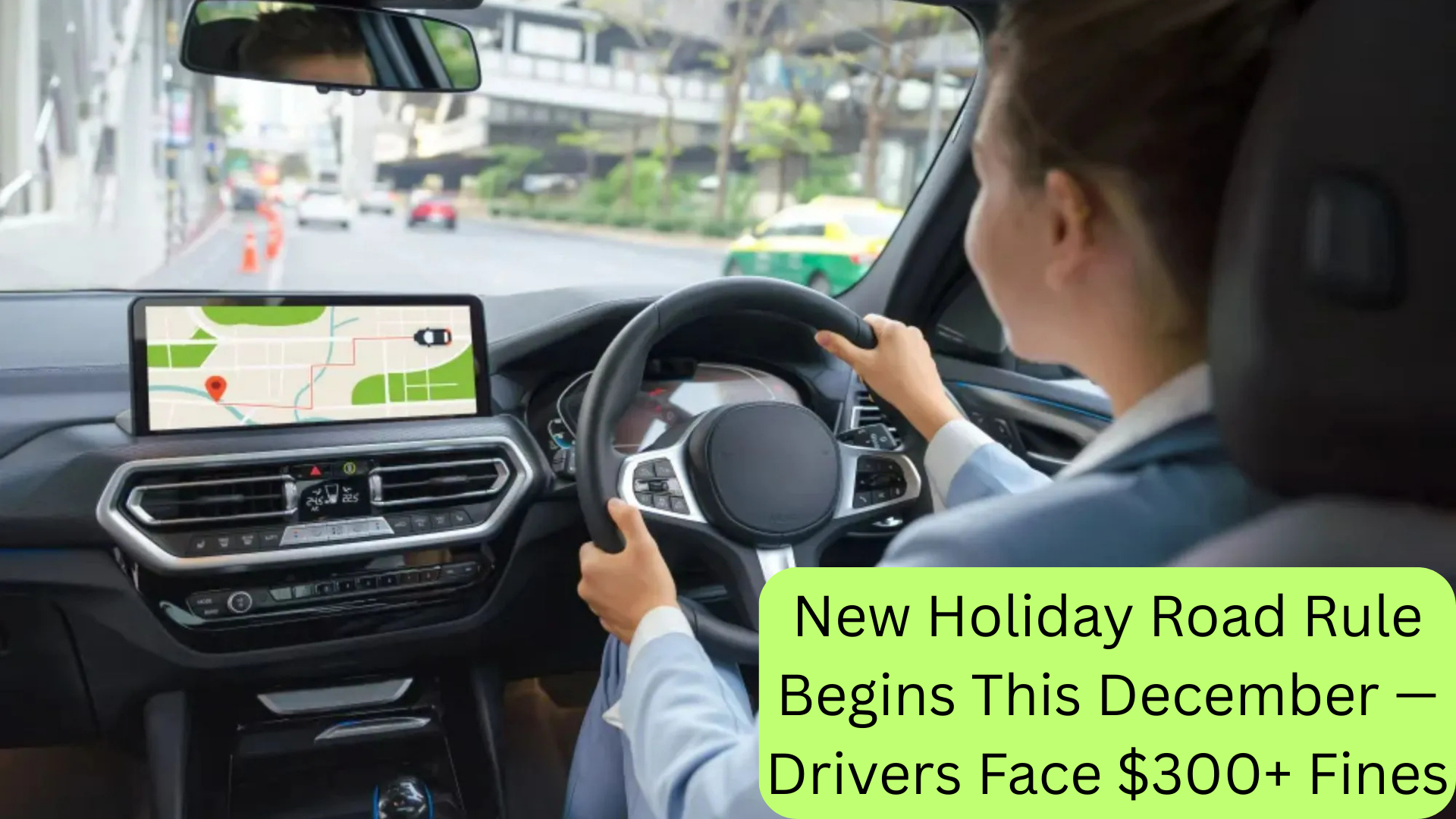
Imagine setting off on a long-awaited holiday trip, the car packed, the kids excited, and festive music playing softly. You’re halfway down the motorway when flashing lights appear behind you — not for speeding, not for your phone — but for a new rule you didn’t even know had started.
That’s the reality many drivers could face this December, as a new holiday road rule comes into effect nationwide, carrying fines of more than $300 for those who fail to follow it.
Background: Why This New Rule Exists
The holiday season is one of the busiest and most dangerous times on the road. Traffic spikes, fatigue increases, and emergency services deal with a higher number of incidents.
Authorities say the new rule is designed to reduce collisions and improve compliance during the peak travel period. It reflects ongoing concerns about roadside safety and the growing number of near-misses reported during holiday traffic over the past few years.
What’s New: Key Rule Changes Starting December 2025
The new holiday road rule, effective from 1 December 2025, focuses on improving safety around roadside incidents and emergency response areas. According to regulators, the rule will be active throughout the holiday travel window.
Drivers must now slow to a safe, reduced speed when passing any stationary vehicle displaying hazard lights — including private cars, breakdown services, tow trucks, and emergency vehicles.
Key changes include:
- Mandatory speed reduction when passing a vehicle stopped with hazard lights activated.
- A minimum slowdown requirement of 20–30 km/h below the posted speed limit, depending on the zone.
- A $300–$450 fine for failing to reduce speed.
- Double-demerit penalties during peak holiday dates in participating jurisdictions.
- Additional enforcement patrols on motorways and popular holiday routes.
Authorities say the rule aims to protect both stranded motorists and roadside workers.
Human Angle: How Drivers Are Responding
For many people preparing to travel, the new rule feels like “one more thing to remember,” but others say it’s overdue.
Daniel Brooks, a 37-year-old father planning a Christmas road trip with his family, says the change surprised him. “I honestly didn’t know this rule was coming until a friend mentioned it,” he said. “But when I think about how risky it is standing on the side of a busy highway, it makes sense.”
Roadside assistance workers, who are often the most exposed, hope the new rule will make a real difference.
“I’ve had cars speed past me at over 100 km/h while I’m changing a tyre,” said Fiona Lang, a mobile mechanic with 12 years of experience. “If slowing down a little can keep us safer, I think most drivers will accept it.”
Official Statements
Transport authorities have emphasised that the holiday period requires extra caution from all road users.
Marvin Kent, spokesperson for the National Traffic Safety Authority, said the rule was introduced following a review of roadside safety data from recent holiday seasons. “We identified a worrying rise in incidents involving stopped vehicles,” he said. “This rule is a simple but effective way to protect both the public and workers who operate in high-speed environments.”
He added that the new fines are intended to encourage compliance without being excessively punitive.
Expert Analysis and Data Insight
Road safety experts say the rule aligns with international best practice and could significantly reduce roadside injuries.
Dr. Elise Morwood, a transport behaviour researcher, explains that reducing speed, even modestly, dramatically increases survival rates near roadside hazards.
“If a driver passes a hazard 25 km/h slower, the risk of a serious collision drops by up to 40%, based on our latest modelling,” she noted. “The change may feel small, but the impact on safety is profound.”
Experts also highlight that holiday periods consistently show higher collision rates due to fatigue, distractions, and heavier traffic.
Comparison Table: What Drivers Must Do Under the New Rule
| Scenario | Old Requirement | New Holiday Rule (Dec 2025) | Penalty for Non-Compliance |
|---|---|---|---|
| Passing a vehicle with hazard lights on | No required speed reduction | Slow down by 20–30 km/h | $300–$450 |
| Passing roadside workers or breakdown services | Slow if possible | Mandatory reduced speed | $300+ |
| Passing emergency vehicles | Already required to slow | Stricter enforcement, holiday patrols | Double demerits possible |
| Travelling during peak holiday dates | Standard rules | Additional enforcement | Higher on-the-spot fines |
Officials expect compliance to improve gradually as drivers become more familiar with the change.
Impact: What Drivers Should Do Now
Motorists preparing for December travel should familiarise themselves with the new requirements before the holiday season begins. Authorities recommend paying close attention to hazard lights, slowing down early, and avoiding sudden braking.
Checking the route in advance, planning rest stops to avoid fatigue, and leaving earlier than usual can also help prevent rushed driving — one of the main contributors to unsafe passing behaviour.
Families travelling long distances should discuss the new rule with all licensed household drivers to ensure everyone understands the obligations before hitting the road.
The new holiday road rule starting in December 2025 aims to make the country’s busiest travel period safer for everyone — from families heading to reunions to workers assisting stranded motorists. The fines may feel steep, but authorities say the goal is to prevent accidents, not punish drivers.
As the festive season approaches, slowing down around hazard lights gives every road user a better chance of getting home safely. A small change in speed could make a big difference on the road this December.
Q&A
1. What exactly is the new holiday road rule?
Drivers must slow down when passing any stationary vehicle displaying hazard lights.
2. When does the rule start?
It takes effect on 1 December 2025.
3. How much do drivers need to slow down?
Generally 20–30 km/h below the posted limit, depending on the location and traffic conditions.
4. What is the fine for breaking the rule?
Between $300 and $450, with possible demerit penalties.
5. Does the rule apply on all roads?
Yes, including highways, suburban routes, and rural roads.
6. Does it apply only to emergency vehicles?
No. It applies to any vehicle stopped with hazard lights on.
7. Will there be more police on the roads?
Yes, holiday-specific enforcement patrols will be active.
8. Are fines higher during Christmas and New Year?
Some states may apply double demerits on peak dates.
9. Why was this rule introduced now?
Authorities identified a rise in roadside incidents during past holiday seasons.
10. Do I need to change lanes as well as slow down?
Only if safe to do so. Slowing down is mandatory; lane changes are optional but encouraged when possible.
11. Will tourists and visitors be expected to follow the rule?
Yes, all licensed drivers must comply.
12. What if traffic is heavy and I can’t slow enough?
Drivers must slow as much as safely possible under the conditions.
13. Are hazard lights now considered a safety signal to drivers?
Yes, they indicate a potential hazard requiring reduced speed.
14. Will towing companies and roadside workers be safer under the new rule?
Officials and experts say the rule should significantly reduce risk.
15. How can families prepare before driving this December?
Review the rule together, allow extra travel time, and stay alert for stopped vehicles.









Leave a Comment