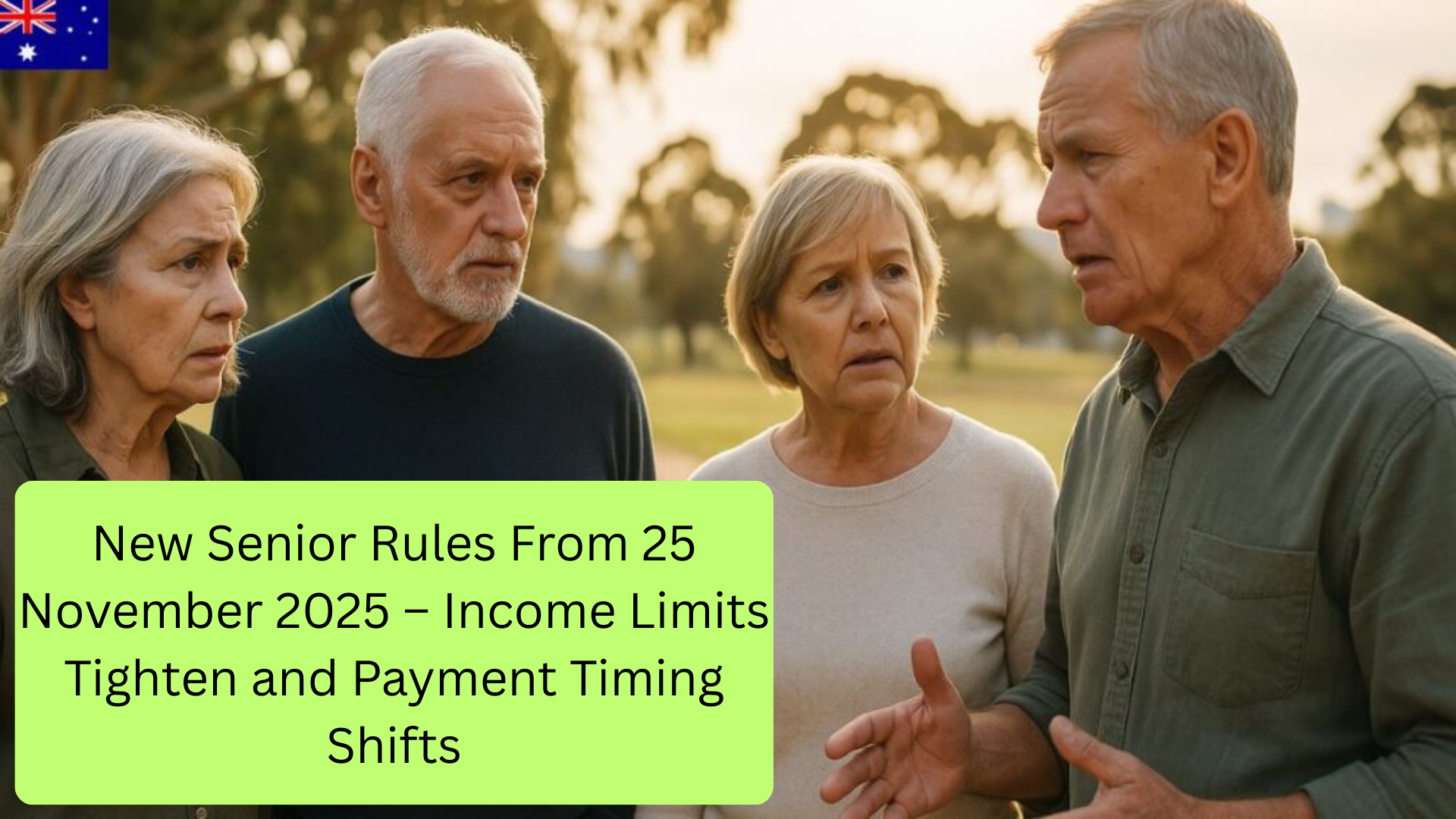
Imagine planning your budget down to the last dollar, relying on the certainty of your payment schedule, only to learn that the goalposts for your primary income source—the Age Pension—are about to move. This is the new reality facing Australian seniors, as Centrelink confirms a major shake-up in eligibility and administration, with New Senior Rules From 25 November 2025 taking effect. These significant changes include a moderate but material tightening of the non-pension Income Limits and an important Payment Timing Shifts that could immediately affect monthly cash flow planning for hundreds of thousands of retirees.
This regulatory adjustment is designed to refine the targeting of welfare support, ensuring the most financially vulnerable Australians receive priority funding. However, the introduction of stricter Income Limits and altered Payment Timing Shifts means hundreds of thousands of seniors across Australia must urgently re-evaluate their employment income and expenditure patterns before the changes kick in. The government is stressing that while these measures are difficult, they are crucial for the long-term sustainability of the Age Pension.
Background: Why the Change in Rules is Happening
The decision to implement the Centrelink New Senior Rules From 25 November 2025 is rooted in a desire to ensure the long-term fiscal sustainability of the Age Pension system and to address what analysts termed “means testing creep.” While the maximum pension rate is rising due to indexation linked to Average Weekly Earnings, the government identified that the existing income test thresholds were allowing an unintended number of seniors with significant part-time earnings or substantial investments to retain a high level of taxpayer-funded pension support.
A detailed Treasury review conducted in late 2025 highlighted that approximately 17% of part-pension recipients were earning private income that pushed them well into the upper bounds of the income test. This indicated that the pension was serving more as a substantial supplement than a genuine safety net for a cohort that, while not wealthy, was relatively financially secure compared to those with zero external income. This finding necessitated the decision to tighten the supplementary Income Limits.
This change, effective 25 November 2025, is fundamentally about reasserting the core principle of the Age Pension: providing financial support based on genuine need. By refining the Income Limits, the government aims to reallocate funds, ensuring the Age Pension system is preserved for future generations. The measure is projected to save the federal budget approximately $1.1 billion over the next four years, funds that can be redirected to other vital senior services in Australia.
What’s New: Key Changes, Income Limits, and Timing Shifts
The new measures include two primary administrative and financial adjustments that will immediately affect Age Pensioners from 25 November 2025. These adjustments require immediate attention and recalculation from anyone relying on a full or partial Age Pension payment across Australia.
Key details regarding the Centrelink New Senior Rules From 25 November 2025 include:
- Tighter Income Limits: The income free area—the amount a single or couple can earn before the pension begins to reduce—will be moderately but significantly lowered. This tightening targets seniors relying on regular part-time work or investment income above the revised threshold, leading to a smaller Age Pension payment for these cohorts.
- Increased Reduction Rate (Taper Rate): For every dollar earned above the new, tighter Income Limits threshold, the rate at which the Age Pension is reduced (the taper rate) will be slightly increased. This makes the financial penalty for exceeding the new allowance more immediate and financially impactful.
- Payment Timing Shifts: To simplify internal processing and better align with public sector pay cycles, Centrelink is standardizing the default payment cycle for all Age Pensioners receiving partial payments from the previous consistent two-week cycle to a new, standardized twenty-eight-day cycle. This Payment Timing Shift, effective 25 November 2025, means recipients will receive thirteen payments annually instead of twenty-six, requiring careful adjustment to monthly budgeting.
- Automated Cross-Checks: Centrelink will introduce new, automated, real-time data matching with the Australian Taxation Office (ATO), requiring more rigorous and timely reporting of all investment and working income. This increased scrutiny ensures compliance with the tightened Income Limits and aims to prevent accidental under-reporting.
The Human Angle and Real Stories
For seniors who utilize the existing income allowances to supplement their pension through valuable part-time work, the tightening Income Limits are more than just a reduction—they impact autonomy and independence. Many seniors work to maintain social connection and cover expenses the pension doesn’t fully meet.
Mrs. Helen Nguyen, a 73-year-old Age Pensioner in Sydney, who earns a modest income tutoring English to new migrants, articulated the impact. “The small amount I earn is vital for keeping my small car running, which allows me to visit my grandchildren across the city and attend medical appointments,” Mrs. Nguyen shared. “With the New Senior Rules and the tightening Income Limits from 25 November 2025, my pension reduction will be more severe. It feels like the government is subtly pushing me out of the workforce, even though my contribution is beneficial to my community and my mental health.”
Mr. David O’Connell, 78, expressed concern over the Payment Timing Shifts. “My rent is due every two weeks. My previous fortnightly payment cycle matched that perfectly,” he noted. “Moving to a 28-day cycle means I have to entirely restructure how I manage my bills. I’ll have to find money from savings to cover the initial gaps, which is precisely what I was trying to avoid by budgeting strictly on my pension.” This administrative change adds significant stress to managing a fixed, minimal budget in Australia.
Official Statements and Commitment to Sustainability
Government officials have acknowledged the potential disruption caused by the Centrelink New Senior Rules From 25 November 2025 but insist they are a crucial fiscal repair measure. They stress the long-term necessity of the changes.
The Minister for Social Services, Mr. Thomas Lee, confirmed the introduction of the new measures. “From 25 November 2025, we are making prudent, necessary adjustments to the Age Pension means test. The moderate tightening of the Income Limits ensures that the pension remains efficiently targeted at those most dependent on it,” Minister Lee stated. “We understand the Payment Timing Shift requires initial adaptation, but it standardizes processing and reduces administrative complexity across the entire Centrelink system. These rules secure the integrity of the Age Pension for future generations of Australians.”
The Minister stressed that the full Age Pension rate remains protected, and that only those recipients with supplementary income approaching the upper threshold will be affected by the tightening Income Limits. He added that the measures affect approximately 350,000 part-pension recipients, but provide greater certainty for the 2.2 million who receive the maximum payment.
Expert Analysis and Data Insight
Retirement policy analysts and economists confirm that the Centrelink New Senior Rules are a fiscally rational measure, though one that requires careful implementation to avoid undue hardship. Dr. Eleanor Voss, a policy researcher specializing in retirement systems, detailed the financial mechanics.
“The government is utilizing two levers: reducing the non-taxable free area (the Income Limits) and increasing the taper rate. By increasing the taper rate from 50 cents to 60 cents per dollar earned over the limit, the Age Pension reduction becomes much steeper,” Dr. Voss explained. “This creates a strong disincentive for seniors with high private incomes to rely on a substantial part-pension. Our projection suggests that the average affected part-pensioner will see their fortnightly payment reduced by an average of $22.50, which is a material impact on a tight budget.”
Dr. Voss also advised that the Payment Timing Shift to a 28-day cycle, effective 25 November 2025, is administratively simpler for Centrelink but functionally changes the recipient’s cash flow rhythm. She advises seniors to treat the pension as a monthly payment and save a buffer to cover the weeks where no payment lands due to the longer cycle.
Comparison of Age Pension Income Test Rules
To clarify the direct financial impact of the Centrelink New Senior Rules From 25 November 2025, the table below compares the existing income free area with the new, tighter limits and the change in the taper rate for Australian Age Pensioners. This comparison shows how much stricter the Income Limits are becoming.
| Rule Category | Recipient Group | Old Fortnightly Income Limit (Approx.) | New Fortnightly Income Limit From 25th Nov 2025 (Approx.) | Net Change |
|---|---|---|---|---|
| Income Free Area | Single Pensioner | $204 | $190 | Tightened by $14 |
| Income Free Area | Couple Pensioners (Combined) | $360 | $335 | Tightened by $25 |
| Taper Rate | All Part Pensioners | 50 cents per dollar over limit | 60 cents per dollar over limit | Increased Reduction by 10 cents |
The table clearly illustrates both the tightening of the Income Limits and the increased reduction rate, reinforcing the government’s commitment to refining the means test from 25 November 2025.
Impact and What Readers Should Do
The primary impact of the Centrelink New Senior Rules From 25 November 2025 is the mandatory need for seniors with part-time work or investment income to re-evaluate their earnings immediately. Failure to comply with the new, tightened Income Limits could lead to unexpected payment reductions and potential debt if income is not correctly reported.
First, Recalculate and Report Income: If you receive a part-pension and have private income, use the new Income Limits of $190 (single) or $335 (couple) to calculate your new pension rate. Adjust your working hours or manage investment withdrawals immediately to mitigate the impact of the tightening Income Limits. Second, Adjust Budget for Timing Shifts: Prepare a four-week budget calendar to account for the move from a fortnightly to a 28-day payment cycle, effective 25 November 2025. This proactive step ensures you can cover fixed expenses without interruption.
Finally, Seek Clarification: If you are unsure how the New Senior Rules or the Payment Timing Shifts affect your personal financial plan, contact Centrelink’s specialist financial information service or a qualified financial counselor in Australia. The responsible action is to proactively adjust your financial strategy to maintain stability under the new regime.
The confirmation of Centrelink’s New Senior Rules From 25 November 2025, involving tightened Income Limits and a Payment Timing Shift, signals a new era of stricter, more fiscally responsible management for the Age Pension in Australia. While the measures are designed to ensure fiscal sustainability, they place a new administrative and financial burden on many part-pension recipients.
For Australian seniors, the message is one of necessary vigilance: the New Senior Rules are changing the landscape of retirement income. By proactively managing your earned income against the tightening Income Limits and adapting your household budget to the Payment Timing Shifts, you can minimize any unexpected negative impact as 2025 draws to a close.












Leave a Comment